
In the world of high-performance automotive and industrial engineering, “silence” is more than just a lack of sound; it is a definitive indicator of mechanical perfection. For a bevel gear set operating within a modern differential, noise is the primary symptom of inefficiency, friction, and potential premature failure. As global standards for NVH (Noise, Vibration, and Harshness) become increasingly stringent—especially for premium brands requiring Benz bevel gear sets—the role of precision grinding has shifted from a premium option to a fundamental necessity for Driven System Solutions.
Understanding why a differential “whines” or “howls” requires a deep dive into the micro-geometry of gear teeth and the transformative impact of the grinding process.
1. The Anatomy of Gear Noise: Why Do Differentials Whine?
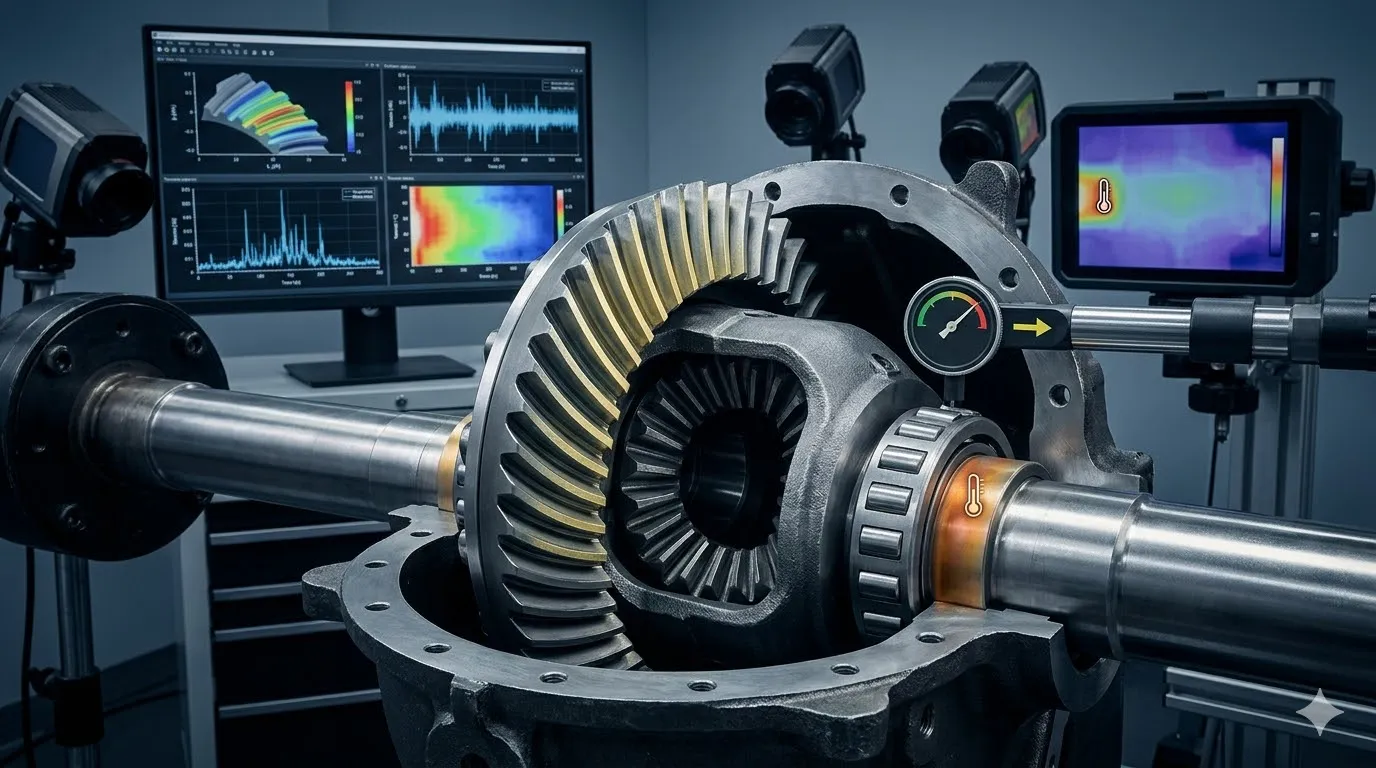
Gear noise in a bevel gear set is typically caused by Transmission Error (TE). TE is the difference between the theoretical position of the gears (if they were perfect, rigid cylinders) and their actual position during rotation.
Sources of TE include:
Pitch Errors: Minute variations in the distance between adjacent teeth.
Profile Errors: Deviations from the ideal mathematical curve of the tooth face.
Surface Roughness: Microscopic “peaks and valleys” left by traditional cutting tools (Face Milling or Hobbing).
When gears with these errors mesh at high speeds, they create high-frequency vibrations that resonate through the axle housing and into the vehicle cabin. Traditional “lapped” gears, while functional, often cannot reach the decibel levels required for modern, quiet transportation.
2. Precision Grinding vs. Lapping: The Technological Leap
For decades, the standard finishing process for a bevel gear set was “lapping”—running the gear and pinion together with an abrasive paste to smooth out imperfections. However, lapping is an empirical process that lacks the absolute control of precision grinding.
The Grinding Advantage:
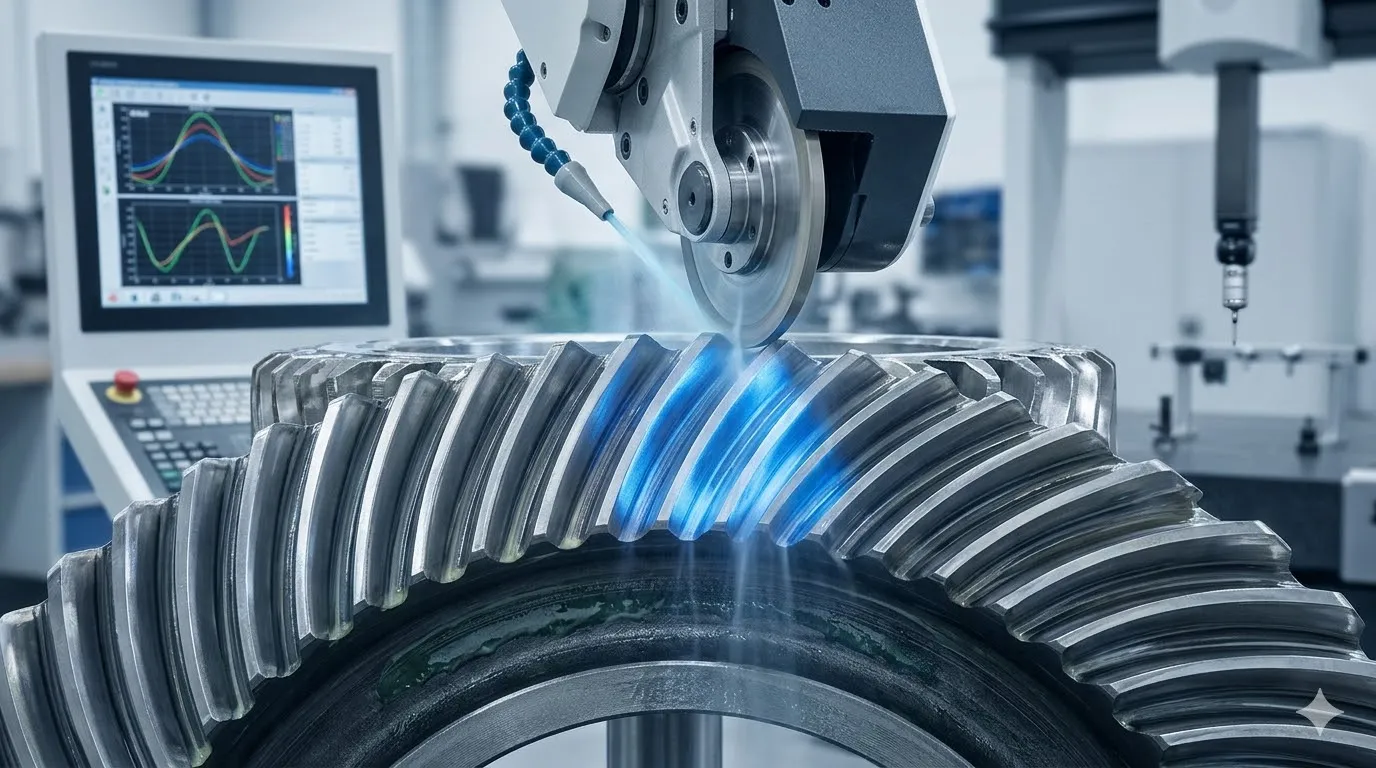
Elimination of Heat Treat Distortion: During the 20CrMnTiH deep carburizing process, heat treatment inevitably causes minor warping of the gear geometry. Lapping can only polish the surface, but precision grinding actually removes material to correct the warped shape, restoring the gear to its intended design coordinates.
Sub-Micron Accuracy: Modern grinding machines (such as those from Gleason or Klingelnberg) can achieve tolerances in the range of DIN 1 to DIN 4. This level of accuracy ensures that the contact pattern adjustment remains stable across all RPM ranges.
Controlled Micro-Geometry (Ease-off): Grinding allows engineers to intentionally “relieve” the edges of the gear teeth (top and end relief). This ensures that even when the Volvo bevel gear set or IVECO bevel gear set deflects under heavy torque, the load stays centered, preventing the metallic “clank” or “whine” associated with edge loading.
3. The Science of Surface Finish: Reducing Friction and Heat
Noise is a byproduct of friction. A rough tooth surface creates a “shaving” action against the lubricant film. Precision grinding achieves a surface finish (Ra) often below 0.4 microns.
How Surface Smoothness Affects Silence:
Elastohydrodynamic Lubrication (EHL): A smoother surface allows for a more consistent oil film. If the “peaks” of the metal surface are higher than the thickness of the oil film, metal-to-metal contact occurs, creating high-pitched friction noise.
Cooler Operation: Lower friction means less heat. Heat causes thermal expansion, which can alter the backlash and move the contact pattern out of its “sweet spot,” leading to noise after long periods of highway driving.
4. System Strengthening: Quietness as a Proxy for Durability
At CK Gears, we view silent operation as the ultimate proof of System Strengthening. A quiet bevel gear set is a gear set with perfect load distribution.
When a Benz bevel gear set operates silently, it means the energy is being transferred through the center of the teeth rather than being wasted as vibration or heat. This lack of vibration directly translates to:
Longer Bearing Life: Vibrations from noisy gears are transferred to the bearings, leading to race pitting and premature failure.
Higher Torque Capacity: Gears that mesh perfectly can handle higher peak loads without the risk of tooth root fractures.
Investing in Silence
For B2B procurement managers, choosing a ground bevel gear set is an investment in brand reputation and reduced warranty claims. While the initial cost of a precision-ground component may be higher than a standard cut gear, the total cost of ownership is significantly lower due to the elimination of noise-related returns and the extension of the overall Driven System Solution lifespan.
CK Gears utilizes the latest in grinding technology and CMM inspection to ensure that every gear we produce meets the “Science of Silence.” Whether you are outfitting a luxury coach or a heavy-duty mining truck, our precision ensures that the only thing your customers feel is the power.