

In the realm of modern precision mechanical transmission, gears are far more than mere power transmitters; they are the critical determinants of system accuracy, service life, and mechanical efficiency. With the rapid evolution of industrial automation and robotics, the industry’s focus has shifted from simple load-bearing capacity to a comprehensive pursuit of high reliability, low noise, and extended operational life.
1. Material Science: The Foundation of Load Capacity
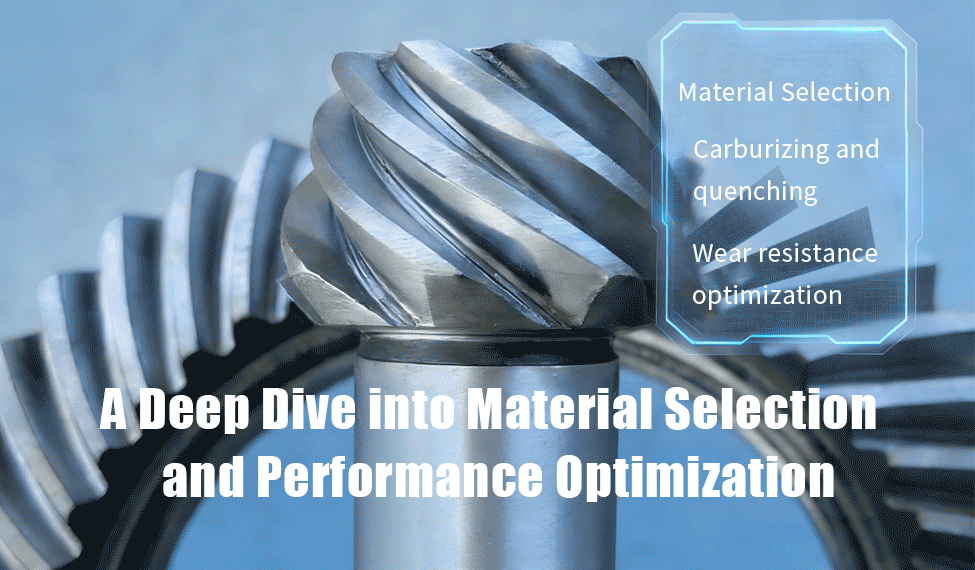
The cornerstone of any high-performance gear lies in its material selection and the resulting microscopic grain structure.
- Material Selection: For heavy-duty and fatigue-resistant applications, alloy carburizing steels—such as 20CrMnTi or 18CrNiMo7-6—are the industry standards. These materials exhibit exceptional contact fatigue strength when subjected to specific treatments.
- Heat Treatment: Utilizing Deep Case Carburizing and Quenching allows gears to achieve a “hard shell, tough core” characteristic. With a surface hardness typically maintained at HRC 58-62 and a resilient core, the gears can effectively resist surface pitting while preventing catastrophic tooth breakage under impact loads.

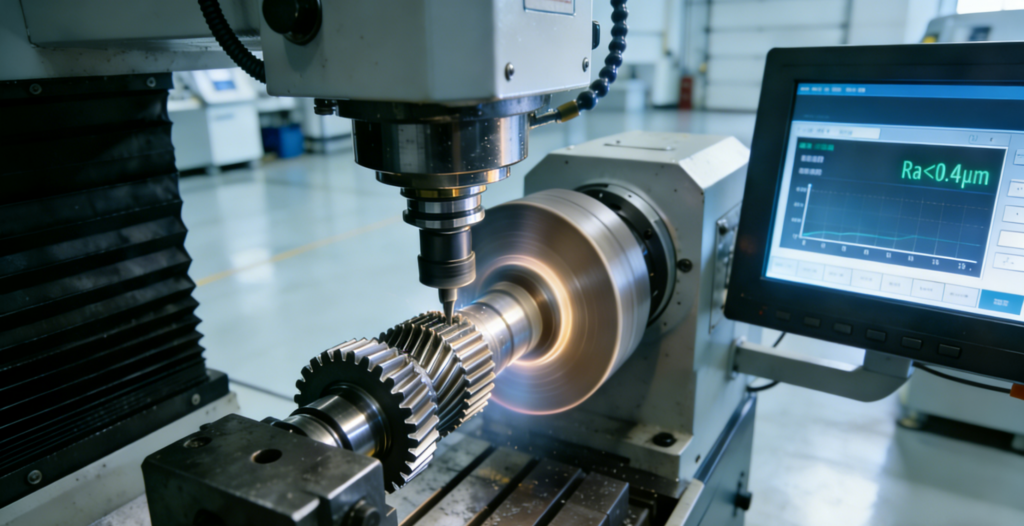
2. Precision Manufacturing: The Pursuit of Sub-Micron Accuracy
Based on advanced technical workflows, the production of high-precision gears transcends basic machining, focusing instead on the ultimate control of geometric tolerances.
Hobbing and Shaping: As the foundational stages, optimizing cutting parameters here is crucial for controlling initial profile errors.
Hardened Tooth Grinding (Gear Grinding): This is the definitive process for elevating precision grades to ISO 4 or AGMA 12 and above. Utilizing CNC profile grinding machines allows for the correction of thermal distortions caused by heat treatment, ensuring the absolute integrity of the involute profile.
3. Systemic Optimization: Tooth Profiling and NVH Control
Under high-speed or variable load conditions, a theoretically “perfect” gear will deviate due to shaft deflection.
Tip Relief: By slightly modifying the tooth tip, we reduce the impact force during mesh entry, significantly lowering high-frequency whine.
NVH (Noise, Vibration, and Harshness): Through precise contact ratio design and micro-geometric compensation, the smoothness of transmission is optimized to meet the stringent acoustic requirements of high-end equipment.
4. Quality Metrology and Reliability Verification
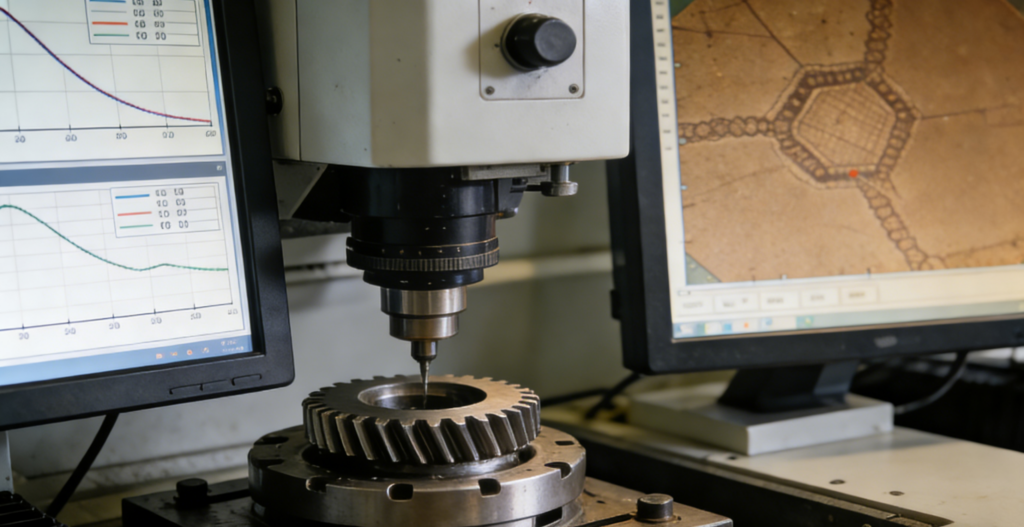
Modern gear manufacturing relies on a rigorous inspection regime to ensure consistency:
-
Universal Gear Measuring Centers: These provide fully automated analysis of pitch deviation, radial runout, and profile/helix errors.
-
Metallographic Analysis: This ensures that the carburized layer depth, carbide distribution, and retained austenite content strictly adhere to engineering specifications.
5. Industrial Applications and Future Outlook
From precision reducers in industrial robotics to high-torque drive units in heavy machinery, high-precision gears are moving toward lightweighting, integration, and self-lubricating designs. By leveraging customized development, manufacturers are not only overcoming spatial limitations in transmission systems but also pushing the boundaries of power density through iterative improvements in materials and processing.
Conclusion
The manufacturing of high-precision gears is an art of balance—balancing hardness with toughness, precision with cost, and theoretical models with real-world operating conditions. Only through end-to-end technical governance can a transmission system deliver superior performance in today’s increasingly demanding industrial landscape.