
In the world of high-precision mechanical engineering, the difference between a high-performance Driven System Solution and a premature mechanical failure often comes down to a fraction of a millimeter. For a bevel gear set, specifically in heavy-duty applications like Benz bevel gear sets, the tooth contact pattern is the ultimate diagnostic tool. It is the visual representation of how power is transferred between the pinion and the ring gear.
A perfectly adjusted contact pattern ensures that the load is distributed evenly across the tooth surface, minimizing localized stress, reducing heat generation, and eliminating the “whining” noise that plagues poorly installed differentials. This guide provides a deep dive into the technical nuances of contact pattern adjustment, aimed at helping fleet managers and engineers extend the service life of their transmission components.
1. Understanding the Geometry of the Bevel Gear Set
A bevel gear set is not a simple “plug-and-play” component. Because of its spiral or hypoid geometry, the gears must mesh at a precise intersection point. At CK Gears, our manufacturing process utilizes Gleason and Klingelnberg systems to ensure that every gear set leaves the factory with a “master” pattern. However, once these gears are installed into a housing—especially in complex Mercedes-Benz axle systems—structural variances in the housing or bearing tolerances can shift the contact point.
Key Terminology:
Toe: The inner end of the gear tooth (closer to the center).
Heel: The outer end of the gear tooth.
Face: The upper portion of the tooth surface.
Flank: The lower portion of the tooth surface.
Drive Side: The side of the tooth that receives pressure during forward motion.
Coast Side: The side of the tooth that receives pressure during deceleration or reverse.
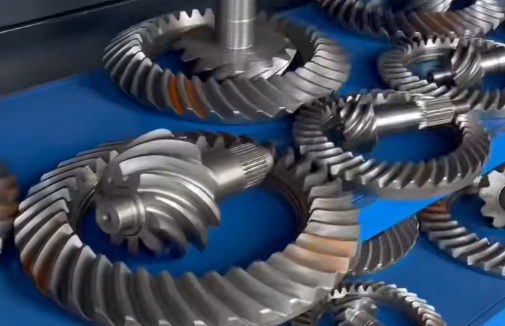
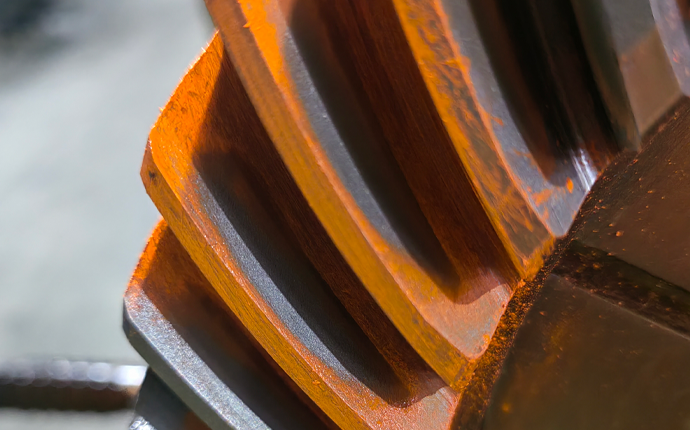
2. Pre-Installation Check: Setting the Foundation for Success
Before attempting to adjust the contact pattern, certain mechanical prerequisites must be met. Even the most skilled engineer cannot adjust a bevel gear set if the underlying hardware is faulty.
Housing Integrity: Inspect the differential carrier for any signs of distortion. In Benz bevel gear sets, the high torque levels can occasionally cause housing “stretch” over hundreds of thousands of kilometers.
Bearing Preload: Ensure that the pinion and carrier bearings are seated with the correct preload. Loose bearings will cause the contact pattern to “wander” under load.
Cleanliness: A single speck of metal debris behind a shim can alter the gear’s position by 0.05mm, which is enough to ruin the pattern.
3. The Technical Process of Pattern Checking
To visualize the contact, we use a specialized marking compound (usually yellow or white gear marking grease).
The Step-by-Step Procedure:
Apply the Compound: Clean 3-4 teeth on the ring gear thoroughly and apply a thin, even coat of marking compound to both the drive and coast sides.
Apply Resistance: This is the most common mistake in the field. To get an accurate reading, you must apply a load to the ring gear while turning the pinion. Use a pry bar or a specialized brake tool to resist the ring gear’s rotation.
Rotate: Turn the pinion through the painted area in both directions multiple times.
Interpret: Observe where the compound has been wiped away.
4. Interpreting the Patterns: Diagnosing Installation Errors
The goal is a “centralized” pattern that is slightly biased toward the toe under no-load conditions, allowing it to migrate toward the center as the gears deflect under high torque.
Scenario A: The Heel Contact
If the pattern is concentrated at the heel of the drive side, the gear is at risk of “chipping” the outer edges.
Solution: Move the ring gear closer to the pinion (decrease backlash) or move the pinion deeper into the housing.
Scenario B: The Toe Contact
Concentrated contact at the toe can lead to “root” failure.
Solution: Move the ring gear away from the pinion (increase backlash) or pull the pinion further out.
Scenario C: High (Face) or Low (Flank) Contact
Face Contact: The pinion is not deep enough. You must increase the pinion shim thickness.
Flank Contact: The pinion is too deep. You must decrease the pinion shim thickness.
5. Specific Challenges for Benz Bevel Gear Sets
When dealing with a Benz bevel gear set, precision is non-negotiable. Mercedes-Benz axles are designed for high efficiency and minimal friction. This means the “window” for an acceptable contact pattern is much smaller than in standard agricultural machinery.
Because we use 20CrMnTiH high-alloy steel and rigorous heat treatment, our gears have high surface hardness. If the contact pattern is off by even a small margin, the hardened surfaces will create excessive friction rather than “wearing in,” leading to rapid overheating of the gear oil and eventual catastrophic failure of the Driven System Solution.
6. How CK Gears Ensures Superior Gear Life
Our commitment to Driven System Solutions starts in the laboratory. By utilizing CMM (Coordinate Measuring Machines) and metallographic testing, we ensure that the tooth geometry of every bevel gear set is optimized for “forgiveness.” This means our gears are designed to maintain a stable contact pattern even under slight housing deflections.
Furthermore, our in-house mold center allows us to create rapid customized tooling for specialized gear sets, ensuring that the “pressure angle” and “spiral angle” are perfectly matched. This reduces the time an engineer spends on-site shimming and re-shimming, as the gears are inherently designed to mesh correctly.
The Path to 1,000,000 Kilometers
A bevel gear set is a masterpiece of mechanical harmony. By following this expert guide to contact pattern adjustment, you are not just installing a part; you are ensuring the longevity of an entire vehicle’s drivetrain. Whether you are maintaining a fleet of heavy-duty trucks or building a custom industrial machine, the pattern tells the story. Listen to it, adjust it with precision, and your Driven System Solutions will provide years of reliable service.
For expert consultation on bevel gear sets or customized transmission requirements, contact the CK Gears engineering team today.