Closing the Gap Between Blueprint and Reality
In the pursuit of higher torque density and extreme precision, the complexity of drivetrain components has reached unprecedented levels. However, a common friction point remains in the global supply chain: the disconnect between the design office and the factory floor. A blueprint that is perfect in a CAD environment can often lead to excessive tool wear, unpredictable heat treatment distortion, or catastrophic failure during mass production.
We believe that high-performance engineering is not a linear hand-off, but a Collaborative Synergy. By implementing a proactive Design for Manufacturing (DFM) framework, we help our partners optimize their components at the earliest stages of development, ensuring that every gear is not only high-performing in theory but also flawlessly manufacturable in practice.
1.Optimizing Gear Geometry
True cost savings and performance gains happen before the first cut of steel. Our engineering team acts as a “Secondary Review Board” for your designs, analyzing the manufacturability of every tooth profile and fillet radius.
Geometry Refinement for Tooling Efficiency
Standard CAD software often designs gear teeth without considering the constraints of the hobbing or grinding tool.
Undercut Avoidance: We analyze small tooth numbers to prevent undercutting, which can weaken the tooth root.
Tip Relief and Profile Modification: We suggest subtle modifications to the tooth profile to compensate for deflection under load, reducing noise and increasing service life without adding manufacturing complexity.
Material-Process Alignment
Choosing the right alloy is only half the battle; ensuring the geometry supports that material’s behavior during machining is critical. We review cross-sections to ensure uniform cooling and optimal grain flow, preventing localized stress concentrations that lead to premature failure.
2.Reducing Deformation and Cost
One of the most significant “Hidden Costs” in gear manufacturing is the high scrap rate caused by heat treatment distortion. Through technical synergy, we proactively mitigate these risks.
Minimizing Heat Treatment Distortion
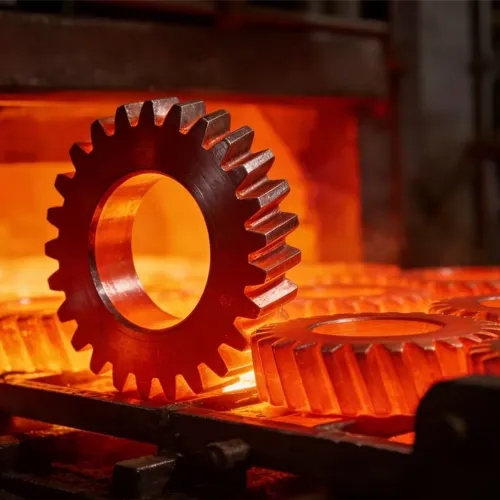
Heat treatment is a violent physical change. Gears with uneven mass distribution or overly sharp transitions are prone to warping.
Symmetry Analysis: We suggest modifications to web thickness and hole placements to ensure symmetrical heat absorption, significantly reducing the need for expensive post-heat-treatment grinding.
Quenching Path Optimization: By suggesting minor adjustments to the component’s geometry, we ensure that the quenching media can flow evenly, preventing the “cracking” or “ovalization” common in complex gear sets.
Shortening the R&D Cycle
In a competitive market, time-to-market is everything.
First-Time-Right Engineering: Our DFM process catches manufacturing errors in the digital phase, preventing the costly “Design-Prototype-Fail-Redesign” loop.
Streamlined Tooling: By aligning your designs with our standardized high-precision tooling, we can eliminate the long lead times associated with custom-made cutters.

3.From Disconnected Design to Unified Production
The ultimate goal of Technical Synergy is to solve the “Big Buyer Pain Point”: the excessive costs and reliability risks caused by design isolation.
Eliminating Hidden Over-Engineering: Sometimes, a design calls for tolerances that are technically unnecessary but extremely expensive to achieve. We provide feedback on where precision matters most and where tolerances can be relaxed to save costs without sacrificing performance.
Risk Mitigation: By involving our production experts at the start, you gain an insurance policy against field failures. We identify potential “Stress Risers” that a simulation might miss but an experienced technician recognizes immediately.
4.Precision Tolerance Allocation and Interference Prevention
In high-speed drivetrain applications, the difference between a silent, efficient system and a failing one often lies in microns. However, setting tolerances that are “as tight as possible” is a common trap that inflates manufacturing costs by $300\%$ without adding functional value. Our DFM framework includes a Scientific Tolerance Review to balance performance with economic reality.
Statistical Tolerance Stack-Up Analysis
Individual component drawings often look perfect, but when multiple gears, shafts, and bearings are assembled, the “Tolerance Stack-up” can lead to binding or excessive backlash.
Rationalized Precision: We collaborate with your engineers to identify which dimensions are “Critical to Quality” (CTQ) and which are secondary. By relaxing non-essential tolerances, we reduce the need for specialized tooling and slow, high-precision passes, passing those savings directly to you.
Assembly Virtualization: We simulate the interaction of the gear teeth under maximum material conditions (MMC). This proactive check ensures that there is zero risk of interference or “tip-to-root” crashing during the final assembly in your facility.
rocess Path Simulation for Complex Geometries
For specialized spiral bevel gears or complex splines, the path of the grinding wheel or cutter can create “Invisible Geometry” that a standard 2D drawing might miss.
Surface Integrity Mapping: We use internal simulation tools to predict the exit path of the cutter. This allows us to suggest modifications to shoulders or adjacent flanges that might otherwise obstruct the tool, preventing the need for expensive EDM (Electrical Discharge Machining) workarounds.
Optimized Contact Patches: Through technical synergy, we can “Pre-Design” the contact patch. We suggest micro-geometrical adjustments—such as longitudinal crowning or profile slope modifications—to ensure that the gears achieve full-load contact only when at operating temperature, preventing edge loading and premature fatigue.
5.Partnership Built on Technical Integrity
A gear is more than a piece of steel; it is a manifestation of engineering logic. At our facility, we don’t just follow your instructions—we join your mission.
By choosing a partner who prioritizes Engineering Synergy, you ensure that your drive systems are optimized for performance, durability, and cost-efficiency. Let’s build the next generation of precision power together, where Design and Manufacture move as one.